Karakuri Kaizen: Low-cost industrial automation
In the context of modern industry and Lean methodologies, the Karakuri Kaizen devices offer a powerful and cost-effective alternative to traditional automation: intelligent mechanical solutions that improve processes, reduce costs and increase productivity — without the need for motors, PLCs or complex sensors. Proper Karakuri implementation not only optimises workflow, but also empowers teams to design continuous improvements directly on the shop floor.
This pillar post will explore what Karakuri is, how it integrates with Lean Manufacturing and Kanban, practical examples of industrial applications, and why Arsam, with products G.S.‑ACE, is the perfect partner for these low-cost automation and modular structure projects.
Table of contents
What is Karakuri Kaizen?
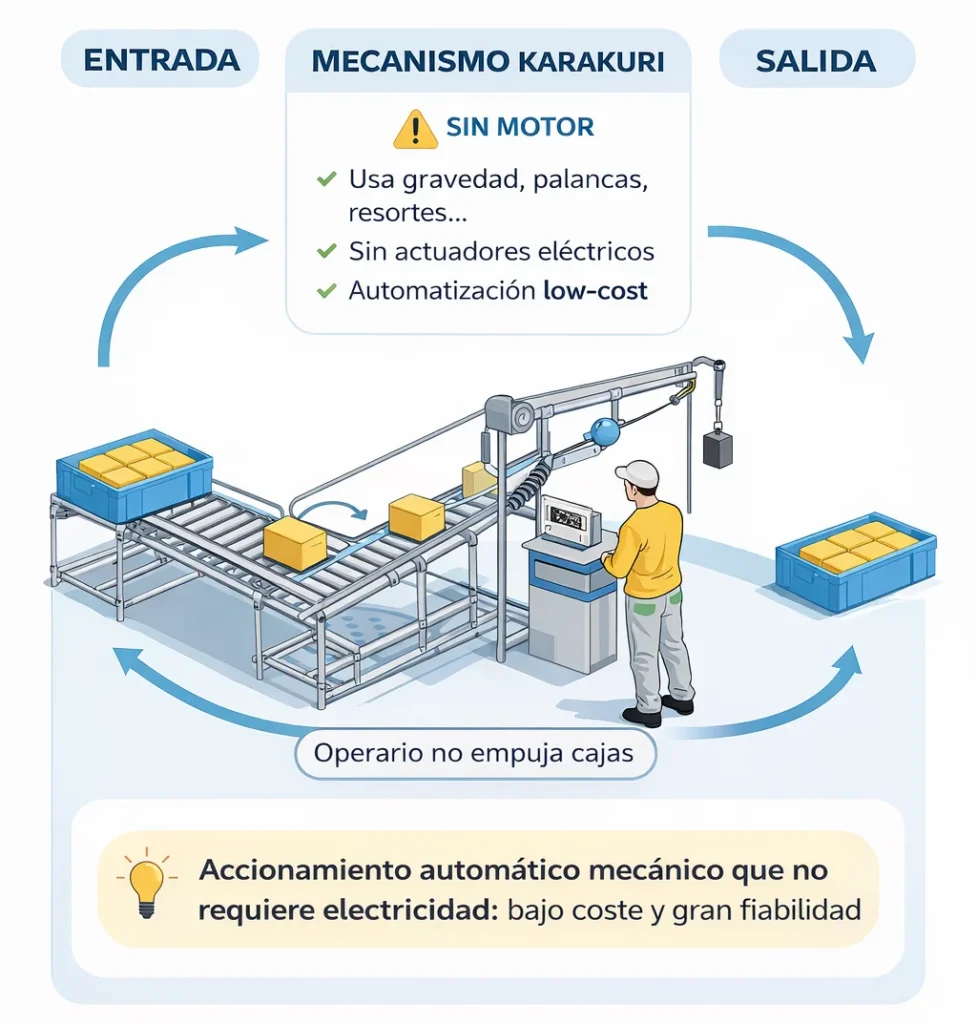
The term Karakuri comes from Japanese and originally refers to mechanical mechanisms or devices that perform actions without external power, relying on physical principles such as gravity, counterweights, springs, levers and pulleys.
When this concept is aligned with the philosophy of continuous improvement (Kaizen) within the Lean Manufacturing solutions, this gives rise to the Karakuri Kaizen:
➡️ simple and effective mechanical automation that streamlines repetitive tasks, reduces cycle times and minimises waste without relying on complex technology.
Karakuri vs Traditional Automation
| Feature | Karakuri Kaizen | Traditional Automation |
|---|---|---|
| Energy | No motor/electrical power | Requires electricity/pneumatics |
| Complexity | Simple mechanics | Electronics and software |
| Investment cost | Low | High |
| Maintenance | Minimal | High |
| Flexibility | High | Medium |
This approach can coexist with advanced automation, but its value lies in solving micro-tasks through frugal, low-cost solutions.
Key Benefits of Implementing Karakuri in Industry
1. Reduction of operating costs
By eliminating electrical actuators and complex control systems, Karakuri devices significantly reduce the costs of CAPEX and OPEX.
2. Lower maintenance and greater reliability
With fewer components prone to failure, downtime and maintenance requirements are reduced.
3. Improved workflow and productivity
The integration of mechanisms that move parts automatically speeds up the work cycles and improves compliance with takt time, a core Lean principle.
4. Improved ergonomics and safety
By reducing repetitive manual movements and unnecessary loads, workplace injuries are minimised and the quality of work is improved.
Essential Components of Karakuri Solutions
G.S.-ACE modular tubes (why they are ideal)
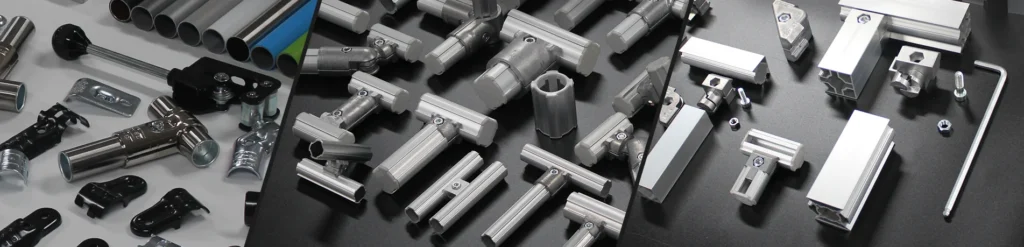
Basic Karakuri structures require modular, robust and easy-to-assemble components. The G.S.-ACE tubes and accessories, distributed by Arsam, offer:
- High mechanical strength ideal for withstanding dynamic loads and stresses
- Modularity and adaptability for rapid prototyping
- Compatibility with other standard components for automation
- Easy assembly without welding, reducing installation costs
This makes G.S.-ACE tubes a key component in Karakuri structures that require fast design and low costs.
Practical Examples of Industrial Applications
Below, we present three real-world Karakuri Kaizen examples applied to production processes, with a technical description and quantifiable benefits:
1. Gravity transfer at assembly stations
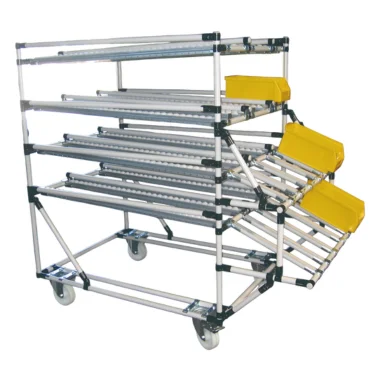
Technical description:
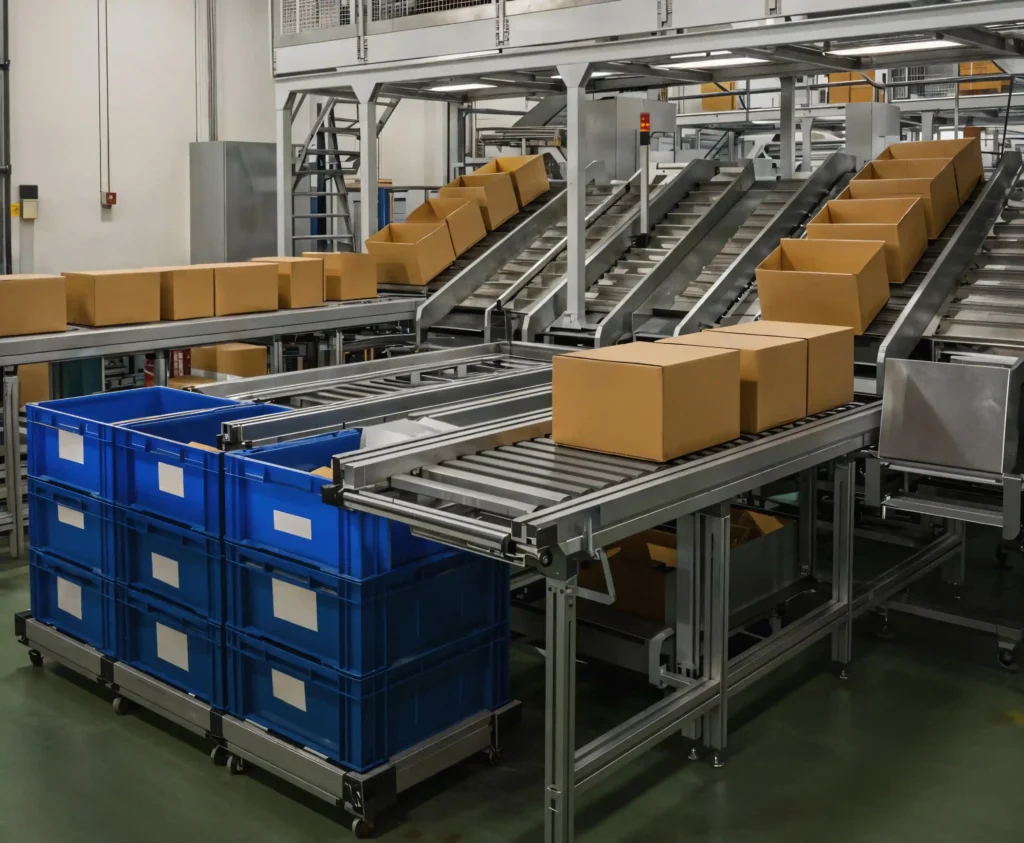
An inclined roller track with releasable stops allows boxes or parts to move automatically between stations without a motor. The angle is calibrated to ensure the appropriate speed based on the load weight and friction.
Typical results:
- Reduced manual handling
- Almost instantaneous transfer cycle
- Low installation costs (just rollers and pipes)
2. Karakuri trolley
A trolley that, once an operation is completed at one station, releases a weight that automatically moves it to the next assembly point.
Technical data:
- Use of counterweights and levers
- Elimination of motors and electronic sensors
Impact:
- Reduced work cycle time
- Freeing operators to focus on higher-value tasks
3. Box separator and transfer unit
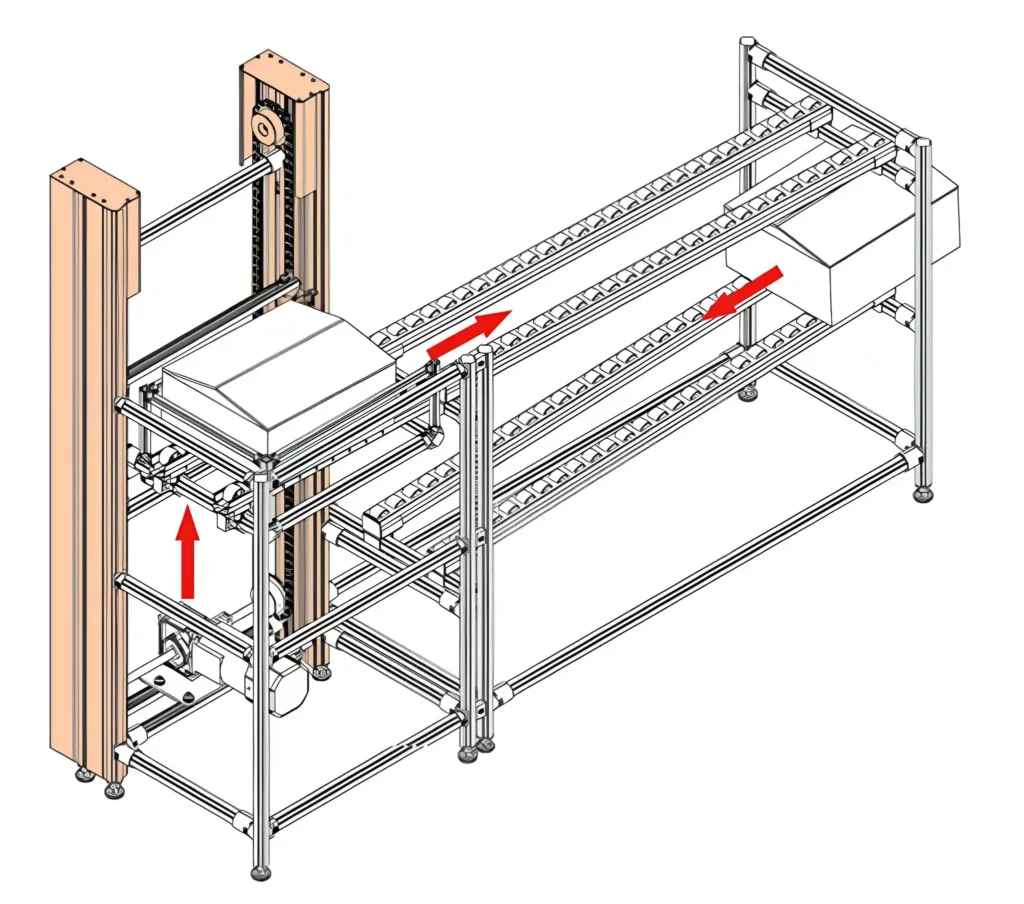
Technical description:
A gravity-based mechanical separation device allows a row of boxes to advance one at a time when an operator removes the first item — without the need for sensors or actuators.
Benefits:
- Improvement of FIFO flow
- Improved ergonomics compared with manually pushing boxes
- Direct integration with workstations
Functional example documented by Beewatec
How to Plan Your First Karakuri Project
Here is a step-by-step guide for implementing Karakuri in your facility:
Standardisation:
Document BOM (Bill of Materials) and maintenance procedures.
Gemba Walk and Process Analysis:
Observe repetitive tasks that generate waste.
Conceptual Design:
Define the required movement: descent, separation or return.
Material Selection:
Use G.S.-ACE tubes for the base structure; select rollers, levers and springs according to the loads.
Rapid Prototyping:
Assemble a prototype to validate the physical principles and resistance settings.
On-Site Validation:
Measure cycle times before and after implementation; assess ergonomics and reliability.
Integration with Lean Manufacturing and Kanban
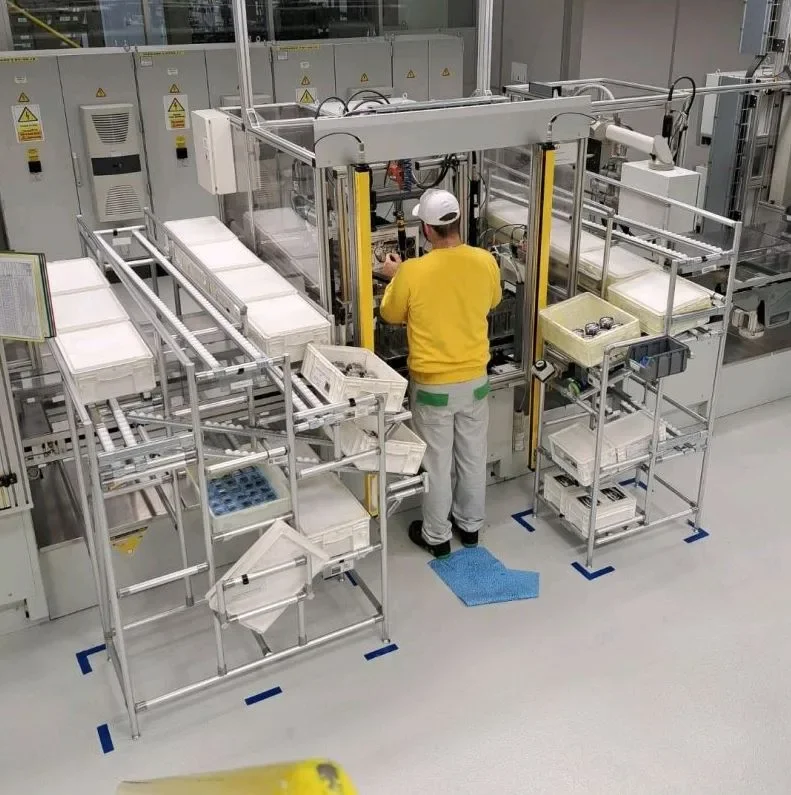
Karakuri does not replace Lean; it enhances it. Mechanical devices that improve flow are aligned with pull systems such as Kanban, helping to eliminate waste and synchronise production with actual demand.
Why Arsam Is Your Partner for Low-Cost Industrial Automation
✔️ Experience in industrial projects with a Lean approach
✔️ Wide range of solutions G.S.‑ACE, ideal for modular structures
✔️ Technical support for component design and selection
✔️ Support for pilot projects and scaling up implementations
Conclusion
The Karakuri Kaizen devices are a powerful tool for low-cost automation, aligned with Lean Manufacturing. By combining modular structures, purely mechanical principles and a focus on continuous improvement, any industrial company can reduce cycle times, improve ergonomics and lower operating costs without technological complexity.
In Arsam we help industrial companies to improve their production environments, integrating technical solutions tailored to each process.
Frequently Asked Questions
What is Karakuri Kaizen and how does it work in industry?
Karakuri Kaizen is a form of mechanical automation that does not use electricity or electronic components. It relies on principles such as gravity, counterweights, levers and springs to move parts, boxes or other items throughout the production process. In industrial environments, it enables operations to be optimised at low cost and with high reliability, improving workflow and ergonomics.
What are the advantages of Karakuri compared to traditional automation?
Karakuri requires no electricity, motors or software, drastically reducing implementation and maintenance costs. It is also flexible, quick to assemble and easy to modify. It is ideal for repetitive applications, improves workplace safety and integrates seamlessly with Lean and Kanban systems.
What materials are used to build Karakuri devices?
The most commonly used components include modular tubes such as G.S.-ACE, metal profiles, rollers, levers, springs and standard plastic or metal parts. These materials make it possible to build robust, adaptable structures without welding or electronic components.
Can I implement Karakuri Kaizen at my plant without making any major investments?
Yes. One of the main advantages of Karakuri is its low entry cost. Effective solutions can be developed using readily available materials and basic mechanical training, enabling in-house teams to propose and implement improvements without relying on external suppliers.
Is Karakuri compatible with Lean Manufacturing and Kanban?
Absolutely. Karakuri originated as part of Japanese Lean culture and integrates naturally into Kanban and continuous improvement environments. Its principles support waste elimination, value flow and the active involvement of teams in process improvement.